
Related reading: Parashat Nitzavim: Summary, Dvar Torah and Quiz and Parashat Naso: Summary, Dvar Torah, and Quiz.
Parashat Noach is the second portion in the Book of Genesis. It tells of a world that has lost its moral direction, of Noach and the ark, the flood, the covenant and the rainbow, a new beginning that is not simple, and the Tower of Babel, where humanity is divided into different languages and peoples. It is a sweeping parashah about responsibility: how to protect life in a turbulent generation, and how to begin again after collapse.
Parashat Noach in Brief
Parashat Noach is read near the beginning of Genesis, after Parashat Bereishit. The Torah reading runs from Genesis 6:9 to Genesis 11:32. The Kotel parashah page notes that in regular years this portion is read around the beginning of the Hebrew month of Cheshvan, and that its major events include the flood and Noach's ark, Noach's drunkenness, the descendants of Noach's sons, and the Tower of Babel.
The parashah moves through several major scenes:
- Noach in a corrupt generation - Noach is described as righteous in a world filled with violence and moral decay.
- Building the ark - Noach is commanded to build an ark that will protect him, his family and the animals.
- The flood - The waters cover the earth, and the old world is wiped away.
- The raven and the dove - Birds are sent from the ark to see whether the land has dried.
- Leaving the ark and the covenant - Noach offers a sacrifice, and the rainbow becomes the sign of the covenant that there will not again be a flood to destroy the entire earth.
- Noach's drunkenness and his sons - The Torah describes a complex family moment after the flood and the way Noach's sons respond to their father.
- The generations of Noach's sons - Families and nations are listed as the beginning of a new world.
- The Tower of Babel - Humanity gathers to build a city and tower, but their language is confused and they are scattered across the earth.
- Avraham's family appears - At the end of the parashah, Terach, Avram, Sarai and Lot appear, preparing the way for Parashat Lech Lecha.
Key Figures in the Parashah
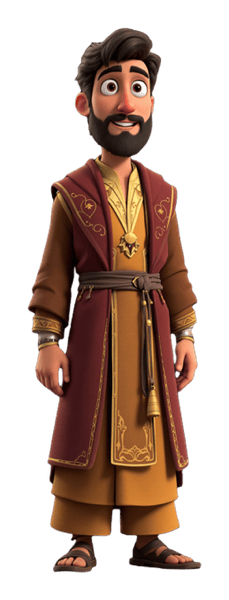
Noach
Noach stands against an entire generation that has lost its way. He is not presented as a public orator or warrior, but as someone who preserves a different path in a broken reality. That is his strength: quiet faithfulness, steady construction of the ark and responsibility for life.
Noach's Wife, His Sons and Their Wives
The Torah does not tell us much about them, but they are part of the rescue and part of the new beginning. Through Noach's family, the world continues after the flood, raising an important educational question: how can a family carry a season of fear, patience and rebuilding together?
Shem, Cham and Yefet
Noach's three sons become the heads of families and nations. After the flood they also appear in the story of Noach's drunkenness, where sensitivity to their father's dignity is tested. The story teaches that the new world still needs moral repair.
The Generation of the Flood and the People of Babel
The generation of the flood represents corruption and violence. The people of Babel represent unity with real power, but also danger when unity becomes pride and the erasure of human difference. In both stories, the same question arises: what do human beings do with collective power?
Terach, Avram, Sarai and Lot
At the end of the parashah, the Torah turns to the descendants of Shem and the family of Terach. Avram, Sarai and Lot leave Ur Kasdim toward the land of Canaan and reach Charan. This is the transition from the story of humanity as a whole to the story of Avraham and his family.
Places and Spatial Ideas
- The ark - an enclosed place of protection, waiting and responsibility for every living creature.
- The earth after the flood - a world that seems to begin again, yet carries memory and responsibility.
- Noach's altar - a moment of gratitude after leaving the ark.
- The rainbow - a sign of covenant and a reminder that the world is meant for repair, not destruction.
- Babel - the place where human unity becomes a project of power, and languages divide.
- Ur Kasdim and Charan - closing locations that prepare for Avram's journey in the next parashah.
Central Idea: Starting Again Without Forgetting Responsibility
Parashat Noach is not only a story about a flood. It is a story about what happens when responsibility disappears from the world, and what is required in order to begin again. Noach preserves life inside an ark, but after the flood it becomes clear that a new beginning is not magic. Even after the waters recede, people still have to build a home, a family, a language, a moral path and a future.
That is why the rainbow is so important. It does not erase the memory of the flood; it turns that memory into covenant. It reminds us that the world is fragile, that human actions matter, and that even after great breakage we can choose life, care and repair.
A Short Dvar Torah for Parashat Noach
Noach's ark is built over time, plank by plank, before the flood begins. We can ask: why does the Torah describe an ark rather than a quick miracle that lifts Noach above the waters? Perhaps the Torah is teaching that rescue begins before the storm. A person builds an ark of values, family, good deeds, learning and prayer - and only later, when the waters rise, there is something to hold onto.
But the ark is not the final destination. Eventually one must leave it. A person who survives the flood is not called to remain protected forever, but to build a better world. This is a gentle message for the Shabbat table: there are times to enter the ark, protect the home and guard the heart; and there are times to open a window, send out a dove, step outside and bring goodness into the world.
For children, it can be said simply: the ark is like a safe place of goodness. Every kind act, every gentle word and every small responsibility is another plank that strengthens it. But once we build an ark in the heart, we use it to help others too.
The Haftarah for Parashat Noach
The common haftarah for Parashat Noach is from Isaiah chapter 54. According to Chabad custom, the reading is Isaiah 54:1-10, while many communities continue through Isaiah 55:5. A community's own custom should be checked before publishing a full text or printable sheet.
The connection to the parashah is clear: the haftarah refers to the "waters of Noach" and to the divine promise not to bring total destruction again. If the parashah tells of the flood and covenant, the haftarah gives the brokenness a voice of comfort: even after exile, distance or storm, kindness, rebuilding and return are possible.
Parashat Noach for Children
A good way to learn the parashah with children is to divide it into six pictures:
- Noach builds an ark.
- The animals enter the ark.
- The flood falls and the world is covered with water.
- The dove returns with a sign of life.
- The rainbow appears as a sign of covenant.
- The Tower of Babel teaches about language, pride and scattering.
Conversation question for children: what small "plank" can we add this week to our home ark - helping, listening, cleaning up, saying a kind word or caring for a friend?
Questions for Children and Adults
Questions for Children
- Who built the ark?
- Why did Noach bring animals into the ark?
- Which bird returned with a sign that the land was beginning to dry?
- What does the rainbow symbolize in the parashah?
- What happened to the language of the people of Babel?
Questions for Adults
- What does it mean that Noach was righteous "in his generations"?
- What is the difference between the sin of the flood generation and the sin of the people of Babel?
- How can the rainbow be understood as a covenant sign and not only as a natural phenomenon?
- What does Parashat Noach teach about responsibility toward family, society and animals?
- Why does the Torah end the parashah with Terach's family and Avram?
Parashat Noach Quiz
- In which book of the Torah is Parashat Noach found?
- What is the Torah-reading range of Parashat Noach?
- What were the names of Noach's three sons?
- Who was sent from the ark and returned with a sign of life?
- What was the sign of the covenant after the flood?
- What did the people of Babel want to build?
- What happened to the language of the people of Babel?
- Who appears at the end of the parashah in preparation for Parashat Lech Lecha?
CTA: Continue to the Parashat Noach quiz and see how much you remember about the ark, the flood, the rainbow, the Tower of Babel and the family from which Avraham's journey begins.
Frequently Asked Questions
What is Parashat Noach?
Parashat Noach is the second Torah portion in Genesis. It covers Noach and the ark, the flood, the covenant and rainbow, the descendants of Noach's sons, the Tower of Babel and the appearance of Avram's family at the end.
What is the Torah-reading range of Parashat Noach?
The reading runs from Genesis 6:9 to Genesis 11:32. It begins with Noach in his generation and ends with Terach, Avram, Sarai and Lot in Charan.
What is the central idea of Parashat Noach?
One central idea is that a new beginning requires responsibility. The flood reveals the depth of corruption, while the ark, covenant and rainbow teach care for life, repair and commitment to a better world.
What is the haftarah for Parashat Noach?
The haftarah is from Isaiah chapter 54, with differences among communities regarding where the reading ends. It connects to the parashah through the reference to the "waters of Noach" and the theme of comfort after destruction or storm.
How can Parashat Noach be taught to children?
It is helpful to teach it through clear images: ark, animals, flood, dove, rainbow and Tower of Babel. Then children can discuss responsibility, care for life, family dignity and the proper use of group power.
Does this page include the full text of the parashah?
Developer Implementation Notes
Recommended schemas: Article, BreadcrumbList FAQ Page and HowTo for "how to learn Parashat Noach with children." On mobile, begin with a short summary and then navigation buttons: Summary, Figures, Dvar Torah, Haftarah, Quiz and FAQ. The quiz should be displayed as a short interactive module with expandable answers.